
Earlier in the year we wrote about scientists’ prediction that we would likely see an El Nino weather phenomena form over the Pacific. We have now entered this El Nino period and it looks likely to be incredibly strong and long lasting. The effects of El Nino are complex and wide ranging and most directly affect countries around the Pacific Rim where the weather phenomenon is expected to cause severe winter storms and drought into 2027.
Meteorologists are already sounding confident that next year will be comfortably the hottest year on record. Closer to home the direct effects are less pronounced, it may be the case that the most significant impact comes from food scarcity and unaffordability and general impacts on the rate of inflation and cost of living as global food systems and supply chains are disrupted. For a country that imports almost half of its food and already has some of the highest grocery costs in Europe, the UK could be particularly exposed.
This prompted the UK Government to issue calls for the public to begin stockpiling food and preparing their own strategies for how to deal with natural or manmade disasters. While this kind of call is unnerving it is also long overdue and disaster preparedness is fairly common across other developed economies. However, as is often the case in the UK, there is a risk that we prove too timid to actually follow through on what needs to be done to tackle an issue. In many European countries their disaster preparedness programmes are far more advanced. In the Netherlands, Germany and the Nordics, apps and booklets have been produced and distributed which provide advice on sterilising water and locating bunkers.
A major issue with these efforts is that they are often framed as individuals or families taking care of themselves. While individual or familial preparedness is important, becoming resilient to climate impacts and other disasters requires state intervention (e.g. by constructing new water dams, investing in fire services etc). A recent paper which explored how access to essential services such as healthcare, mobile phone signal and even functioning schools, was a strong predictor for vulnerability and the ability for households to bounce back following Hurricane Irma, highlights this point. The other neglected aspect of preparedness in the UK government’s recent calls is the role of community resilience. As Rebecca Solnit’s excellent book A Paradise Built in Hell states: “Disaster demonstrates this, since among the factors determining whether you will live or die are the health of your immediate community and the justness of your society.” Interestingly, the Dutch disaster preparedness booklet explicitly recommends that Dutch citizens engage with the neighbours and understand what their needs and skills are. Providing communities with the tools and space to rebuild community bonds and design their own climate adaptation approaches (excellent examples of which can be found in Elizabeth Hazel’s new book Frontierlands) should form a prominent part of the UK government’s approach to preparedness.
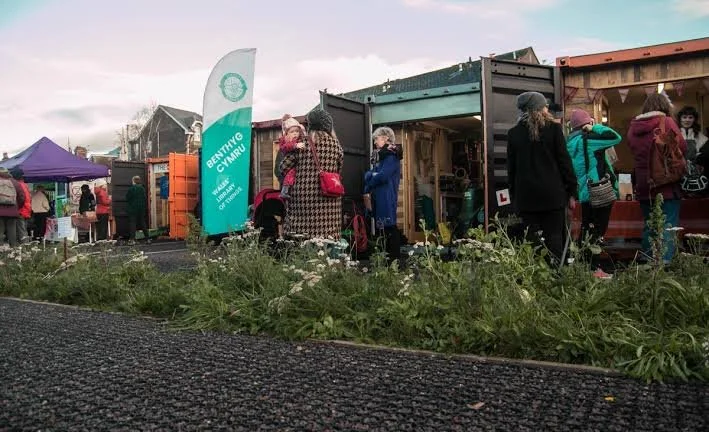
Image taken from Benthyg Cymru’s social media account showing their stall at a community event. Benthyg supports Libraries of Things across Wales, building community and resilience along the way.